Turning a Lived Health Journey into Outstanding Science: The CWSF and TEAM BASEF Success Story of Judy Wang and Isabell Zhang

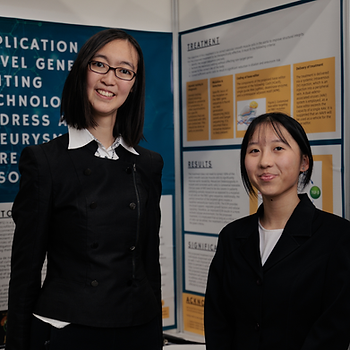
As Editors at BioEndeavor, we were so inspired by this project and learning how one team member's health journey inspired this outstanding CWSF project, we want to share Judy and Isabell's story to empower other students, teachers, and parents. Science fairs are about celebrating innovation as well as creating impact for our communities and societies through STEM. These stories should be broadly shared as we strive to bring purpose to STEM. Thank you Judy and Isabell for sharing your touching story. The Inspiration Marfan syndrome (MFS), a connective tissue disorder caused by FBN1 gene mutations, affects 1 in 5000 individuals. Current interventions for MFS are insufficient; they only mitigate symptoms and must be continuously maintained. Judy herself was born with a de novo case of MFS, and has always felt an inexplicable curiosity toward its causes. She enjoys pondering solutions to this disorder using modern medical innovations. Isabell has a deep fascination for bioengineering and genetic editing and a penchant for research. We decided to collaborate on this project because we are close friends and feel that we complement each other’s strengths; Isabell is a diligent, efficient researcher and Judy is a passionate scientific communicator.
The Innovation In this project, July and Isabell synthesized scientific research to identify technologies for eliminating the severest MFS symptom: aortic aneurysm and dissection. We propose a novel genetic modification tool, base editing, for repairing aortic cells by changing individual letters in the genetic code to correct missense mutations (the leading cause of MFS). To conduct the following research, predominantly qualitative scientific evidence was synthesized.
Of the 112 sources reviewed from platforms such as PubMed and ScienceDirect, 64 were cited, with criteria including relevancy, credibility of authors, corroboration with other sources, and recency (ideally published within the decade). We specifically focused on the potential effectiveness of base editors in minimizing the effects of Marfan syndrome by editing aortic smooth muscle cells to correct the FBN1 gene, resulting in a healthier extracellular matrix and overall more resilient aorta. Base editors have rescued mouse models with similar aortic dilation and restored MFS stem cells to normal morphology and karyotype. This treatment should ideally be administered pediatrically, leveraging next-generation sequencing panels to identify the mutations’ loci, utilizing Sanger sequencing to confirm results for quality control, and using adeno-associated virus 9 as the vector for intravenous injection.
The foremost challenge will be to attain the critical mass of edited cells to create a positive feedback loop, significantly improving cellular environment regulation and patient outcomes. Since existing methods to manage MFS often involve years (if not a lifetime) of avoiding strenuous physical activity, medication, and potentially invasive surgery, this treatment shows promise in providing a more proactive and permanent way to reduce the impact of symptoms. This potentially increases life expectancy and quality for an estimated 1.6 million MFS patients worldwide. To clinically implement this treatment, further research is needed to facilitate functional base editors. This process will use online models to simulate FBN1 gene mutations using DNA libraries and assess the ability of various base editor iterations to correct missense mutations to restore the unaffected phenotype. Next, animal model preclinical trials can be used to determine the effectiveness of the treatment in whole organisms. The treatment must follow all legal frameworks and be approved for clinical trials before it can be implemented. In the future, a similar theory can be applied to zonule cells to minimize ectopia lentils in MFS patients.
Canada-Wide Science Fair Experience We genuinely found the Canada-Wide Science Fair to be the most challenging week of our lives, and also the most rewarding week. Since the moment we boarded the airplane bound for Edmonton wearing our bright scarlet Team BASEF jackets, we knew we were about to have the time of our lives. From practicing our presentations with peers late at night to strategizing answers for judges’ potential questions even later at night, we were surely hard at work. From witnessing a revolutionary senior care robot prototype to hearing a riveting presentation about a novel antifungal medication, we were indubitably inspired. From meeting healthcare professionals with PhDs to debating bioethics with Team Canada Science Fair members, we definitely did a lot of networking. From touring the huge Edmonton Mall to attempting break dancing during the farewell party, we unquestionably had fun. Most importantly, we formed deep bonds with truly unforgettable people. From yelling musical theatre songs to trading virtual Pokémon cards, we certainly made friends to last a lifetime. CWSF left us with many cherished memories and ultimately inspired us to dream bigger, work harder, and fall in love with science more.
Future Aspirations
Isabell aspires to work in the healthcare field after university to merge her intellectual curiosity for the biomedical sciences with real-world applications to help patients, especially by leveraging her experience with bioengineering and psychology. Judy aims to become a pediatrician because she believes that a child’s trust is precious, and their smile after feeling better is even more so; she also intends to educate youth about health as a proactive prevention by using her skills as an engaging presenter.


Comments